Ray Eade was fifteen years old when he first walked into Toganmain woolshed. That was April 1965. Sixty years later, he walked back in — and the memories came with him.
Ray came to Toganmain as a rouseabout, picking up wool during the 1965 shearing season. He was young and green, and by his own cheerful admission, not entirely up to the pace of it. There were ten rouseabouts working the shed that year. "I wasn't that gun, don't worry about that," Ray says, laughing. He stayed through that season and into 1966, finishing up at sixteen. It was, as he puts it, a long time ago. But stepping back into the shed at our recent Open Day, it didn't feel that way.
"Wow," he said, as he looked out across the catching pens. "Does it just blow your mind." He stood quietly for a moment, taking it in. The shed that had once been all noise and motion and wool baskets and bodies was still and silent, but the scale of it brought it all back. He reckoned the catching pens held around two and a half thousand sheep at a time - though he was quick to add with a grin, "don't quote me on that" - and recalled that with the covered sections included, the figure could have been closer to six thousand four hundred. A lot of sheep. A lot of work.
He remembers the wool baskets cluttering the floor. Ten rouseabouts constantly in each other's road. The controlled chaos of a working shed at full pace. "It was just so busy," he says. "Every - you're getting in your road."
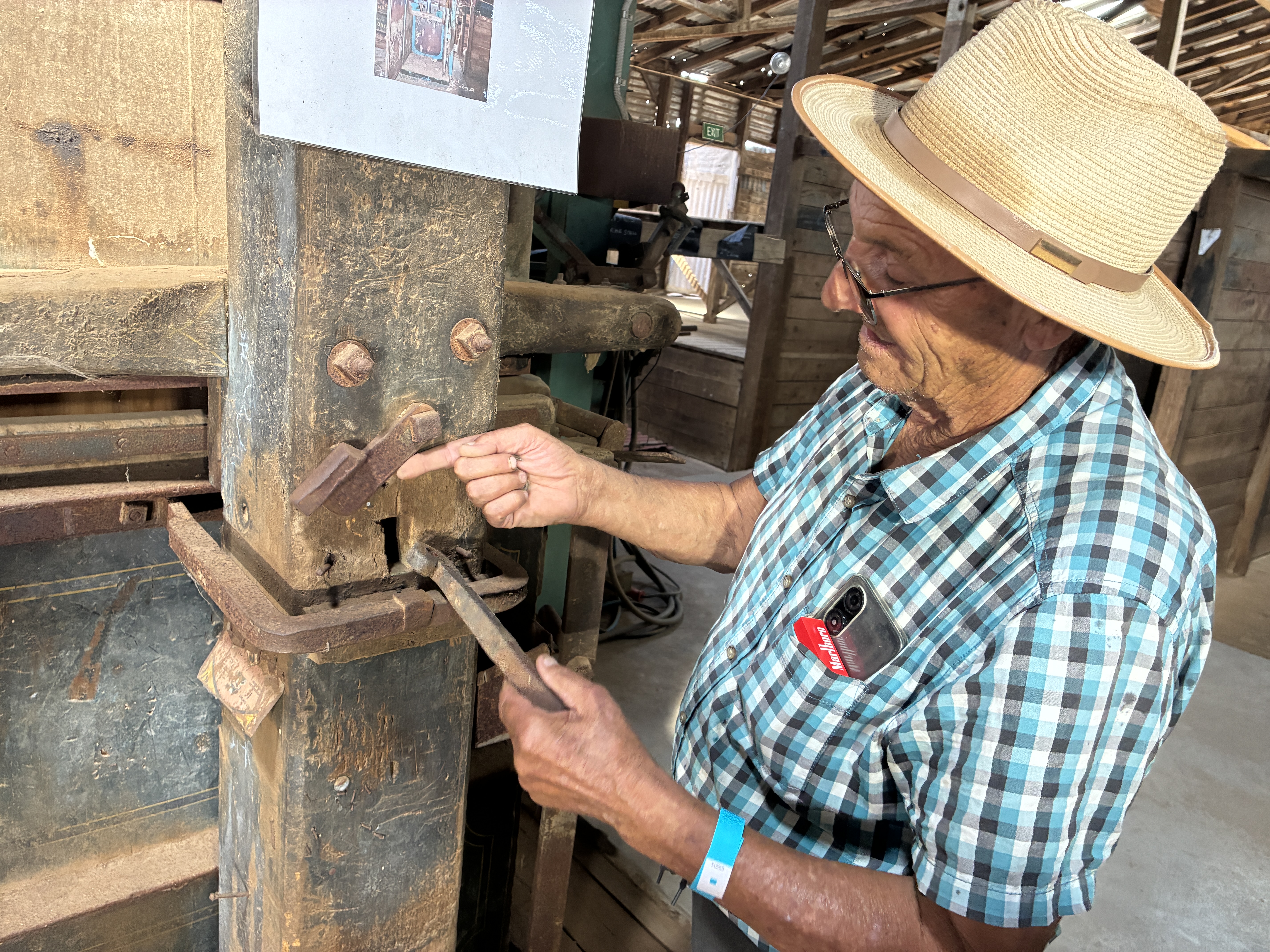
Ray also loaded the Ferrier wool press during his time at Toganmain, and he hadn't forgotten how it worked. Walking over for a closer look, he noticed something that had been quietly wrong for who knows how long - a pin in the side of the press, inserted the wrong way up. Sixty years on from his days as a rouseabout, Ray set it right. We have the photo to prove it.
One of the most valuable things Ray brought back with him was knowledge - specifically, things he had been told by older shearers during his time here. Men like Dick Denning, long since passed, who carried their own memories of an earlier era. It was Dick who told the young Ray about the original layout of the shed's shearing stands - his recollection being that there were originally ninety overhead stands, to which a further ten were later added, giving the hundred that the shed became known for. And it was from those older men that Ray heard the story of where Toganmain sat in the history of machine shearing in Australia.
When the Wolseley company brought its revolutionary mechanical shears to Australia in 1888, Dunlop Station on the Darling River was the first shed in the country to complete a full shearing by machine. Ray had been told - by shearers who were there, or who knew those who were - that Toganmain was second. "I quite believed him," Ray says of Dick Denning. "He was a reliable old fella." It is the kind of detail easily lost to time, passed from generation to generation by word of mouth, kept alive only by the people who bother to come back and tell it.
Ray also reflected on how the sheep themselves have changed. In his day at Toganmain, Corriedales were common - smaller animals, carrying less wool than the Merinos that have since come to dominate. Today's Merinos are bigger and heavier-fleeced still, and Ray agreed with a laugh that today's sheep would probably struggle to fit down the shutes. The shed was built for a different era. That, in many ways, is precisely what makes it worth preserving.
He came to the Open Day with his older brother Neville, and before he left, he had a message for the volunteers who have given so much to bring this place back. "It's a credit to you guys," he said. "A hundred and fifty years of history. Doesn't it bring back memories."
It does, Ray. Come back any time.