Family history research has a way of delivering surprises, and Donna Outtrim's discovery about her great-grandmother Julia Lutton Morison is a perfect example of how official records don't always match family memory - and sometimes there's a very practical reason why.
A One-Month Discrepancy
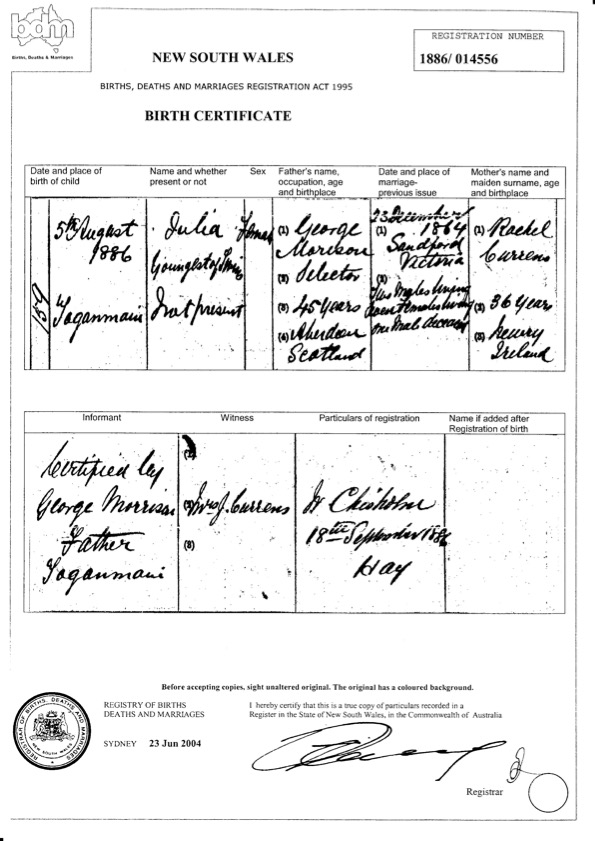
Julia and her twin sister Agnes Jane Todd Morison were born at Toganmain Station on July 5, 1886. At least, that's what the family bible said. That's what the birthday book recorded. That's what everyone in the family had always known. So when Donna purchased Julia's birth certificate while organising a family reunion and researching her mother's family history, she expected confirmation of the familiar date.
Instead, the certificate showed a date exactly one month off.
The mystery deepened when Donna looked into the registration laws of the time. In 1886, parents could register a birth for free—but only if they did so within 60 days. After that, there was a fee. George Morison, the twins' father, registered their births on September 18, 1886, at Hay. That was 75 days after the actual birth date.
The family's theory? George and Rachel Morison, already stretched thin financially, faced the prospect of paying fees to register two births. Their solution was simple and ingenious: adjust the birth date by exactly one month. Suddenly, they were within the 60-day window, and no fee was required.
It's a small detail that speaks volumes about the practical challenges faced by families on remote pastoral stations in the 1880s. Every penny mattered.
The Morison Family at Toganmain
The twins weren't the only Morison children born at Toganmain. Their younger brother William Joseph arrived on March 4, 1883. Their oldest sister, Mary Lutton Morison, married George William Neil at the station in 1886—the same year the twins were born.
But how did this Victorian family end up on a pastoral station in the Riverina? The answer involves equal parts ambition, opportunity, and the gruelling realities of 19th-century pioneering.
An Epic Journey: From Casterton to the Riverina
Leo Morison, a descendant of Julia's oldest brother George Lutton Morison, shared the remarkable story of how the family came to Toganmain. In 1880, George Morison and his brother-in-law Joseph Currans learned that Toganmain Station was to be subdivided. They travelled from Casterton, Victoria, to investigate the opportunity. What they found convinced them to take up land holdings next to each other on October 28, 1880. George selected 640 acres under conditional purchase.
George then returned to Casterton to collect his family for the journey back to his new selection. The expedition—a snapshot of colonial determination—consisted of a wagonette, a specially-made dray carrying their belongings, a hand-operated chaff cutter, a single furrow plough, and an eight-year-old son bringing up the rear with the spare horses.
The four-week, 400-mile journey was a tale of two halves. The first leg to Echuca was relatively civilised, with better roads, frequent towns for supplies, and accessible water. But after stocking up in Echuca, the family entered more challenging country. Roads became less defined and eventually indistinguishable, towns were scarce, and water had to be carried. George navigated using a compass, and when they finally arrived, a survey map helped them locate their 640-acre selection.
Making It Work - Or Trying To
Life on the selection was never easy. To supplement the family income, George worked at times for Thomas Robertson, the owner of Toganmain Station. He also left to try his luck on the Temora Gold Fields with his brother-in-law William Currans, leaving Rachel and the children to manage the property and try to meet the conditions of the conditional purchase.
By the time the twins were born in 1886 and daughter Mary was married, George had fulfilled the purchase conditions. In December 1886, he sold the property to his brother-in-law Joseph Currans. George and most of his family moved on to take up another conditional purchase at Willurah Station. Their last child, James Philip Morison, was born there on February 12, 1889.
A Widow's Burden
Tragically, George Morison died at Willurah Station on January 20, 1890, at just 48 years old. He left behind his 41-year-old widow Rachel with seven of their ten living children—aged between one and fifteen years—to care for alone.
It's hard to imagine the weight that fell on Rachel's shoulders: a remote station, young children, and the constant struggle to make the land productive enough to survive.
Connections Across Generations
Donna's research into her great-grandmother Julia not only uncovered the birth certificate mystery but also connected her with Leo Morison and opened up the broader story of the Morison family's pioneering journey. It's a reminder that behind every birth certificate, every land selection record, and every family bible entry lies a human story—of courage, hardship, practical problem-solving, and the ties that bind families across generations and vast distances.
And sometimes, those stories start with a simple question: Why is this date wrong?


Comments powered by CComment